Monday, 13 December 2010

Players who suit MUDs

Here are my notes on Richard Bartle's article entitled 'Players Who Suit MUDs'. Bartle divides MUD players into four categories.

Killers
Achievers
Explorers
Socialisers

He then uses the following graph to represent the players' source of interest in a MUD.


ACTING
                  Killers            |                  Achievers
                                     |
                                     |
                                     |
                                     |
                                     |
          PLAYERS -------------------+------------------- WORLD
                                     |
                                     |
                                     |
                                     |
                                     |
                  Socialisers        |                  Explorers
                                INTERACTING


As Bartle explains, the X and Y axis of the graph show general areas in which players who suit MUDs can be defined, while the corners of the graph further separate the players. Below I have listed the main points associated with a player who fits into each of Bartle's four main categories.

Killers:

This type of player falls into the 'acting' section of the graph. They are the type of player who plays games to act on other people. They are not as concerned with interacting with the game world as the other types of players. Generally speaking killers act on other players without their consent and may enjoy doing things in a game world which would be punishable in real life. Killers play the game to be destructive and damaging even if their crimes cause them to be punished in the game world.

Achievers:

Achievers fall into the 'acting' and 'world' sections of the graph. This is because they are the type of player that acts with the game world to reach goals. An achiever's main goal is to master the game and while other players add a feel of authenticity, they are not the reason an achiever plays a game. Their main objective is to complete everything there is to complete and master  each aspect of the game.

Explorers:

As you can see from the graph, explorers interact with the game world. They are not the sort of player who has to achieve everything or interact with every player. They are the sort of player who plays the game to interact with the world and explore everything it has to offer. Explorers are often more knowledgeable on the intricate details of the game world as they spend their time exploring everything within it. While they may collect points and items, it's not their goal to be the best, they enjoy playing the game for everything it has to give.

Socialisers:

A socialisers main objective is to interact with other players in the game world. They play the game to talk with others and strike up friendships between themselves and other players. These type of players see the game merely as a setting in which they can interact with others that have a similar interest as themselves.

As you can see, each player can be separated quite effectively into these categories. While i generally agree with this, I also feel that many players fall into a number of these areas. Take myself, for example. While I would mostly put myself in the explorer category, I often find myself striving to be the best within a game which usually leads me into the killer category. I also like to socialise with other players and while i would say this is the category i fit into least, I do occasionally play games to interact with other. I personally feel that a players mood will ultimately decide on which category they will fall into each time they play a game, it certainly does with me.

Bartle then goes on to explain how different styles of players act when confronted with a player who has a totally different objective to them. While i won't go through and explain each one individually, i will touch on a few points. Generally speaking, if an explorer comes into contact with another explorer or a socialiser with another socialiser, their goals and objectives will be the same. Explorers will have respect for one another while socialisers will be able to communicate for hours about subjects they are both interested in. Achievers will see other achievers as competition which killers will view each other in the same way.

When one type of player comes into contact with a player who has opposite goals, they tend to have less respect for them than if they were someone with similar interests. They will often feel that their way of playing the game is correct and may regard the other player as a 'loser' for playing it differently. Socialisers are generally viewed as pointless among the other types of players as they aren't competition and while they may have some interesting things to say about the game, they add nothing to it. They may often be viewed with pity or irritation by players with opposite goals.

I feel this article does a good job of describing the different motivations that players have for playing games. It touches on most styles of play and was a very interesting read. MUDs themselves have helped develop these styles of play so now most of us can relate to one category more than another.

Thursday, 2 December 2010

Phil's Favourite Films

With all my posts being about games, I thought I would make a post about my other love, films. While i regularly go to the cinema, most of my favourite movies are classics pre-2000. Below is a list of my top 10 films.

1. Psycho (1960)
2. The Good, The Bad and the Ugly
3. The Godfather Part II
4. The Shining (1980)
5. Inception
6. Scarface
7. American History X
8. The Godfather
9. Fight Club
10. Pulp Fiction

Tuesday, 9 November 2010

Bibliography Task

So, being reading week I thought it best to finally complete the bibliography blogging task we were set by Eddie. I decided to go down a route which interests me the most, Formula 1! I have endless magazines and books on the subject so thought I would try my hand at doing some bibliographical references from them. Below are some of the examples i put together, all comments are welcome.


Books:
De Cet, M. (2008) Formula One Race Circuits the changing architecture of race tracks. Wigston, Leicester, UK: Abbeydale Press.

Schlegelmilch, R W & Lehbrink, H. (1999) McLaren Formula 1. Köln, Germany: Könemann.

Jones, B. (2008) Grand Prix 2008. London, UK: Carlton Books.

Contributions to Books:

Cooper, A. (Nov 2009) "Kimi by a second". In B. Jones (ed) The Official Formula 1 Season Review 2009. Yeovil, Somerset, UK. Haynes Publishing. pp192-198

Roberts, J. (Nov 2009) "Starry Night". In B. Jones (ed) The Official Formula 1 Season Review 2009. Yeovil, Somerset, UK. Haynes Publishing. pp213-218

Articles:
Reynolds, J. (2010) “What do you get when you give 104 F1-mad computer game designers £10million and a two-year deadline?” F1 Racing, October No. 176. pp82-84. Middlesex, UK: Haymarket Consumer Media.

Hughes, M. (2008) “How next year’s rule changes are set to banish Barcelona boredom.” Autosport, May 1st. p27. Middlesex, UK: Haymarket.

Monday, 8 November 2010

Retro Game Review

So, after completing the first quarter in our initial year as Computer Games Design students, we have been tasked with writing our first essay. I will be the first to admit that essay writing wasn't something that first drew me to this course, but I'm actually really looking forward to compiling my thoughts on a game dated pre 1985.

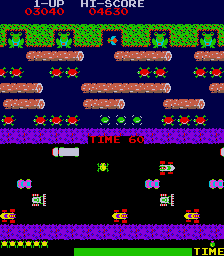
The first thing then, was to decide on a game to review. With so many options available, I spent literally hours sifting through various retro arcade games until i decided on my final choice, Frogger. Introduced to the world as an arcade game back in 1981, Frogger was challenging, rewarding and ultimately, like many other games of it's time, incredibly frustrating! The aim is for the player to get a specific amount of frogs to their home one at a time. To do this, the player must successfully manage to maneuver their frog across a busy road while dodging various vehicles, and a pond which contains logs, lilypads, crocodiles and other obstacles.

File:Frogger game arcade.png

I chose the game Frogger because it is one I know well. It has taken up many hours of my life in the past and I felt it a good idea to write about a game I was already familiar with. I look forward to revisiting this game and rambling on about its sheer brilliance! Feel free to comment if you have any thoughts on my game selection or the blog post as a whole.

Friday, 22 October 2010

Don't Be a Vidiot!

Our reading task for this week was Greg Costikyan's article entitled 'Don't Be a Vidiot'. In short, the term 'Vidiot' describes someone who's sole understanding of games derives solely from video games.

Published in 1998, the article may seem somewhat outdated, although many of his points are relevant to video game designers today. He states that the current video game industry is full of dull titles and most games that are released today only differ slightly from others within the same genre. Here, I feel he definitely has a point although arguments can of course be made to state otherwise. I recently played a game called 'Heavy Rain' on the Playstation 3. I must say, I thoroughly enjoyed it and will admit to never having seen or played a game with the same feel. This, in my opinion, is an example of a new style of game, a game which is based much more on user interaction and intelligence, a rare thing in today's run and gun style game industry.

Shortly after mentioning that the industry is full of dull titles, Costikyan writes that games which succeed best are those that are original and new. This definitely brought my thoughts back to 'Heavy Rain'. One of the reasons i loved it was that it was new, it had a style of gameplay which I had never before seen implemented in a video game. Sure, I enjoy playing Call of Duty and Grand Theft Auto as much as anyone else, but only a game which is innovative and new will get my full praise. I feel much like that in the world of film too. My favourite films are all pre 1990, where new ideas and risks were taken on films to shock and excite the viewer. Today's media seems all too stale for my taste and I welcome games such as 'Heavy Rain and films such as 'Inception' which give me a glimmer of hope that one day film makers and game designers will start taking risks again.

Anyway, i got slightly off topic there, so back to Costikyan's article. One of his main points was that games like 'Pong' didn't start game history. History started with cheaper and simpler games. Games like Chess, Checkers and simple card games were all around decades before the invention of Pong. While it's true that the media industry is moving on at quite a pace, there is definitely still a place for original simple games in today's society. Admittedly, I spend much more of my time in front of a screen than a game board but Costikyan states that, 'A writer who wishes to master his craft must read widely in work from all areas'. This quote is something i fully believe in. It's so important to have a knowledge of game history. Games are a plastic medium and there is so much choice and variety, it's just such a shame that the vast possibilities are rarely explored in today's media markets.

I suppose money plays a big part in this. Just over a year ago i wandered into the Sainsbury's store where i work only to find hoards of people lined up outside. It was 7am and there must have been at least 70 people all breaking down the doors to get their hands on the latest version of Call of Duty. It was with a wry smile that i walked past them all and picked my copy up. At that time I thought to myself, would these people be here to buy a game that wasn't a sequel? Would these people be here to buy a game that was based on a totally original idea? Probably not. While i admire their enthusiasm and commitment i couldn't help wondering what they are potentially missing out on by limiting themselves to just a modern day re-make. It's a shame really that the modern day society in which we live has such a blinkered view on video games and media in general.

I would like to round this post off with one last quote from the article. Costikyan writes, 'if your imagination is based on games only made within the last five years, your imagination will be constrained'. While this time frame would now be extended to the last 20 years, the quote still makes a valid point. How can you create a game that is totally new without first looking back at the history of games? How can you draw inspiration from games that have been made and played to death? Maybe if the media industry of today became aware of the foundations that initially built games and film, we would start seeing a newer, fresher and more original style of entertainment.

Apologies if this post ended up being a rant, but hopefully you will have understood the main points I took from the article. Thanks for reading, all comments are welcome!

Sunday, 17 October 2010

Board Game Iteration

During our first week at University, we were tasked with creating a board game in 15 minutes. This week we revisited those games and looked at what changes could be made to improve them. Below are the changes I made to my game plus thoughts on how they affected it.


1. My first iteration was to introduce a 10 sided dice. I was initially using a regular 6 sided dice but felt that it was taking too long for players to move around the board. The change definitely helped speed up the game and while i would prefer to use a numbered spinner, the dice worked fine. I decided to make this change permanent to my game.


2. My second iteration was to introduce extra areas on the board which players could move to. This was brought in after a play test found that the game could become quite linear and frustrating with all players following the same path. While this change worked to an extent, I decided not to make it permanent as it actually increased the speed in which players were able to move around the board. While it may have given slightly more variety to the game, the way i implemented it meant that the game was over too soon.


3. My third iteration was to introduce a system where the players have to roll the exact number required to cross the finish line. For example, if a player was 5 spaces from the finish, they would need to roll a 5 and only a 5 to win. This change seemed to work really well and the play test resulted in two players battling right to the end. Because of this i decided to make this change permanent.


Due to the amount of play testing, those were the only iterations i made to my game this week. I found it to be a very useful way of not only improving our games but also learning them. Only after playing it numerous times did some smaller issues arise. I have noted these down and hope to make more iterations to my game in the future.

Sunday, 10 October 2010

Paidea and Ludus

Today we learnt about Paidea and Ludus, two contrasting game styles. Paidea effectively means the players  "play" for pleasure, while Ludus games are more constrained by rules, with a clear outcome. Below are examples of both Paidea and Ludus games that i am familiar with.

Paidea:
An example of a Paidea game that i have played recently and am famililar with is 'Paper Toss'. I have it as an application on my Ipod touch and it's clearly just a game to be played for fun. The player is asked to throw balls of paper into a bin at varying distances. There is no real end goal to the game and the player can continue playing for as long as they want without a positive or negative outcome. The Player can create their own objectives however by setting themselves a high score target. This adds an element of player defined goals.

Ludus
An example of a Ludus game is Sonic the Hedgehog. Although this game has changed forms over the years, the basic goals are still in place. 'Get from one end of the level to the other and you move onto the next world'. There are different options and routes to take within the levels but the end goal is always the same and will produce you with the same outcome.

Wednesday, 6 October 2010

Applying Costikyan's theories to a KS1 game

During our lecture yesterday, we applied Costikyan's six key game elements to a Key Stage 1 game called 'shapes' Below are my personal views on how his theories apply to the game.


Interaction:
Although limited, there is definitely interaction in the game. The player is given a choice of three shapes and must click on the correct option to progress through the game. Unfortunately there is no penalty for choosing an incorrect shape. This means the player can continue to click on the next shape without any explanation as to why their first choice was incorrect.


Goals:
The main goal in the game is to select the correct shape from a choice of three which help to build a robot. I suppose you could argue that there are two goals from this, the first being to select the correct shape and the second to build the robot. Although the player doesn't actually get to interactively put together the robot, they are lead to believe that when a correct shape is chosen, they are helping to build it.


Struggle:
There is very little struggle in the game although it does exist. Different difficulty levels allow the player to choose a more challenging set of shapes to select from. This is the only real struggle in the game which leads it to become far too easy and simplistic.


Structure:
Just like 'struggle', there is little structure to be found in the game. having the three different difficulty levels could be classified as game structure but unfortunately the rules of the game don't allow players to influence the outcome. There is also no freedom within the game and it basically consists of a few animations and slides.


Endogenous Meaning:
For me, the endogenous meaning within the game lies in the shapes. They do have value in the game as players need to select the correct one to progress. In the real world, however, the shapes will have no value at all. A counter argument for this could be made as if the player actually learns something about shapes while playing the game, they could use that knowledge in the outside world. Therefore, it would be valuable to them in both the game and real life.


Evaluation:
Let's face it, this game could be made much, much better. Understandably, the age group for which it is aimed at may enjoy the colours, characters and background animations but this will soon get tiresome for anyone. Putting in a scoring or points system would have been an effective way of creating some competition and desire for re-playability. As it stands, I can't see anyone playing through this game more than once.
I also feel it could be much more educational, after all it is meant to be a learning tool. Some sort of feedback given to the player upon choosing the right or wrong shape would be a simple way of teaching a user about the subject. With the game as it is, any user with any ability can reach the end of the game without knowing anything about the shapes given out as choices.
That being said, even if they only play a small role in the game, Costikyan's key elements all seem to be present.

Greg Costikyan's theories on game design

After having recently read through Greg Costikyan's theories on game design, here are my personal thoughts on each of his key game design elements.


Interaction:

Within interaction, i feel that Costikyan talks about giving players various choices and interactions which allow them to shape the game state. He also mentions that puzzles are an integral part to any game and those puzzles need a purpose or end goal for a player to successfully interact with the game. 

Goals:

When Costikyan spoke about goals, I thought the underlying message was that a player needs a goal to achieve which creates purposeful and progressive interaction. Without a goal or an endgame, user defined or otherwise, there is no point in playing the game.

Struggle:


A game needs the correct level of struggle to make it enjoyable. If the challenges and struggle are too difficult, players will find the game frustrating. Similarly, if the game has little struggle it becomes too easy and the player will become bored. Creating the correct balance of difficulty is key to creating an enjoyable and rewarding game.

Structure:


Structure filters the player through the game to achieve their goal. Game structure adds to the overall struggle. For example, rule structure adds to the challenge and struggle while also influencing player behaviour.

Endogenous Meaning:


I thoroughly enjoyed reading this section of the paper. Here, Costikyan describes that something which has great in-game value actually has next to no value in the real world. There are exceptions of course, with game memorabilia being sold on internet auction sites for, at times, large sums of money. The point he makes though, is that without the game, that piece of merchandise or memorabilia would have no value in the real world. I feel this topic could be debated for a very long time, although i generally agree with what he is saying.

Evaluation:


All the elements Costikyan mentions are key to creating a game. They also all link together which make them so important. Arguments can be made about whether or not these elements actually make a 'fun' game, but i personally feel that they all play an integral part in actually creating a game.


After discussing this in class we then applied Costikyan's theories to a very simple KS1 game. My views on this will be published soon. After all, it is getting late and we do have an early lecture tomorrow....

Thursday, 30 September 2010

A Q&A with the blog creator

Q1. What is the title of the last film you saw at the cinema/ online or watched on DVD?

A. The last film I watched at the cinema was called Buried. Buried is a film starring Ryan Reynolds and is set entirely in a coffin, buried deep underground. Reynold's character, Paul Conroy, is trapped and armed with only a lighter and a mobile phone. After contacting the local authorities, it's a race against time as they try to save Paul before he suffocates or worse, gets buried!
I thoroughly enjoyed the film and thought Reynolds was fantastic in his role. I've seen a number of films which have been set in one location but rarely are they done well enough to hold the viewers interest. Alfred Hitchcock's Rope and Lifeboat are two other films i would recommend to anyone who enjoyed this.
The last DVD i watched was 'The Good the Bad and the Ugly' starring Clint Eastwood. I have seen it so many times now and it's definitely one of my favourite ever films. Anyone who enjoys classic cinema or westerns should definitely watch it.

Q2. How often do you read a newspaper?

A. I probably read a newspaper about three to four times a week. I tend to buy and read the Daily Mail. I find it a relatively enjoyable read as it's more intellectual than the Mirror and the Sun but not quite as hard work as The Guardian or the Independent. As long as it keeps me updated with the latest sport and world news, i will generally read anything though!

Q3. How many hours a week do you spend playing video games?

A. I usually spend around 5-6 hours per week playing video games. I mostly play console games although do occasionally play strategy games on the PC. I'm currently playing Little Big Planet and Heavy Rain, both on the Playstation 3. Heavy Rain is a fantastic game and although i'm not very far in, i'm finding it challenging but rewarding at the same time. It plays just like a film but everything you do has a big consequence as you move further through the game. It's really inspired me as to different directions that are available in the game market. I have never played a game like Heavy Rain before but i can see vast possibilities in how the style of gameplay it uses can be used in other genres.

Q4. How many hours a week do you spend playing games other than video games?

A. The only games I play that aren't video games are card games. I enjoy playing casino games like Texas Hold em' poker and Blackjack. i often hold a poker night at my house which gives me and my friends a chance to chat, gamble and have a bit to drink!

Q5. What is the last live performance you attended?

A. The last live performance I attended was last summer when I went to see Muse at Wembley. They were absolutely fantastic and I would definitely go again. I haven't been to as much live music as I would like but whenever I get a chance to go I do so. Wembley Stadium is a brilliant place and i have been there on a number of occasions for sporting events. I'm going to the American Football game there at the end of October which i'm very excited about.

Q6. What was the last book of fiction you read?


A. The last book of fiction i read was Stephen King's: The Shining. The Stanley Kubrick film adaptation is one of my favourite movies so i decided to read the book. Although the book and the film do vary slightly, i found the book to be a fantastic read. I have always been a fan of horror novels with Stephen King's books being some of my favourites.

Q7. What was the last Non-Fiction book you read?


A. The last Non-Fiction book i read was England under the Tudors by G.R Elton. It's a history book detailing the period of the Tudor dynasty from Henry VII to Elizabeth I. Whilst it is detailed and informative it is also lengthy and contains many of G.R Elton's personal opinions about the events during that took place during that period. With this in mind it was important to read it with an open mind and take into account other writers opinions to the same events to achieve a balanced view.

Q8. What was the last art gallery you attended?

A. The last art gallery i attended was a small affair in the Bury Cathedral Cloisters last December. Whilst this was not officially a gallery, the exhibition itself was of personal interest as it contained pictures painted by a member of my own family. Because of this my personal judgement of the artwork may have been biased. The pieces were predominantly watercolour paintings with a small collection of oil and acrylic work. All the artists were amateurs and there was a full range of subjects from seascapes to ballerinas, still life and modern art. Many of the paintings were enhanced by the choice of frame and lighting effects.